Starting a business means wearing a dozen hats at once. You’re the CEO, marketer, accountant, and customer support team all in one. But here’s the problem: according to Asana, knowledge workers spend 60% of their time on “work about work” instead of meaningful execution. For founders, that often looks like chasing status updates, organizing tasks across tools, sitting in alignment meetings, or rewriting the same information in different places. It’s not just inefficient. It’s unsustainable.
Virtual assistants for startups have evolved from a luxury to a necessity. They're no longer just task-doers; they're strategic partners who help you reclaim time, access specialized skills, and scale efficiently. Whether you need help with inbox management, social media, or customer support, hiring a virtual assistant can save founders considerable time each month – time that directly translates into growth.
A virtual assistant (VA) is a remote professional who provides administrative, creative, or specialized support to businesses. Unlike traditional employees, VAs work remotely using digital tools like Slack, Asana, and Zoom to manage workflows and complete tasks ranging from calendar management to market research.
For startups, VAs fill critical gaps that prevent progress. Time savings alone justify the investment: founders report saving 30-40 hours monthly by delegating repetitive tasks. That's nearly a full work week back in your schedule.
Cost efficiency makes VAs accessible: According to our internal data at Collab Fabrik, hiring a full-time administrative employee costs $2,500+ monthly in salary alone, excluding benefits and office overhead. A virtual assistant starts at $8 per hour (from 990 per month), with flexible part-time and full-time packages available to match your needs.
The shift to remote work has normalized virtual collaboration. Virtual assistants for startups aren’t just nice to have, they are essential strategic assets for those operating lean.
The value of virtual assistants for startups becomes clear when you look at how they impact time, cost, and scalability.
Time is your scarcest resource as a founder. Virtual assistants handle inbox management, scheduling, travel planning, and customer follow-ups, giving you back nearly a full work week every month.
Startups need diverse capabilities: social media management, content writing, bookkeeping, lead generation.
Startups need diverse capabilities, from social media management and content writing to bookkeeping and lead generation. Hiring specialists for each role can easily exceed $150,000 per year. Virtual assistants for startups offer a cost-effective alternative: according to internal data from Collab Fabrik, a cross-functional VA starts at $8 per hour. For part-time support (20 hours per week), this translates to approximately $8,320 annually, while full-time support (40 hours per week) costs around $16,640 per year. That's a fraction of the cost of building a multi-role team, while still delivering comparable output across functions.
Unlike employees with fixed salaries, virtual assistants offer variable support. Start with 10 hours weekly, then scale to 40 hours as revenue grows. This elasticity prevents overhiring during slow periods and ensures capacity during growth spurts.
Traditional hiring takes 4-6 weeks. Virtual assistant agencies can match you with qualified talent in under 7 days. Many VAs start immediately, and agencies handle payroll, compliance, and training.
Many virtual assistants work from regions like Asia, Eastern Europe, or Latin America. This creates a "follow-the-sun" workflow: you assign tasks at day's end, and they're completed by morning. For startups competing globally, this effectively extends productive hours to 16-20 daily.
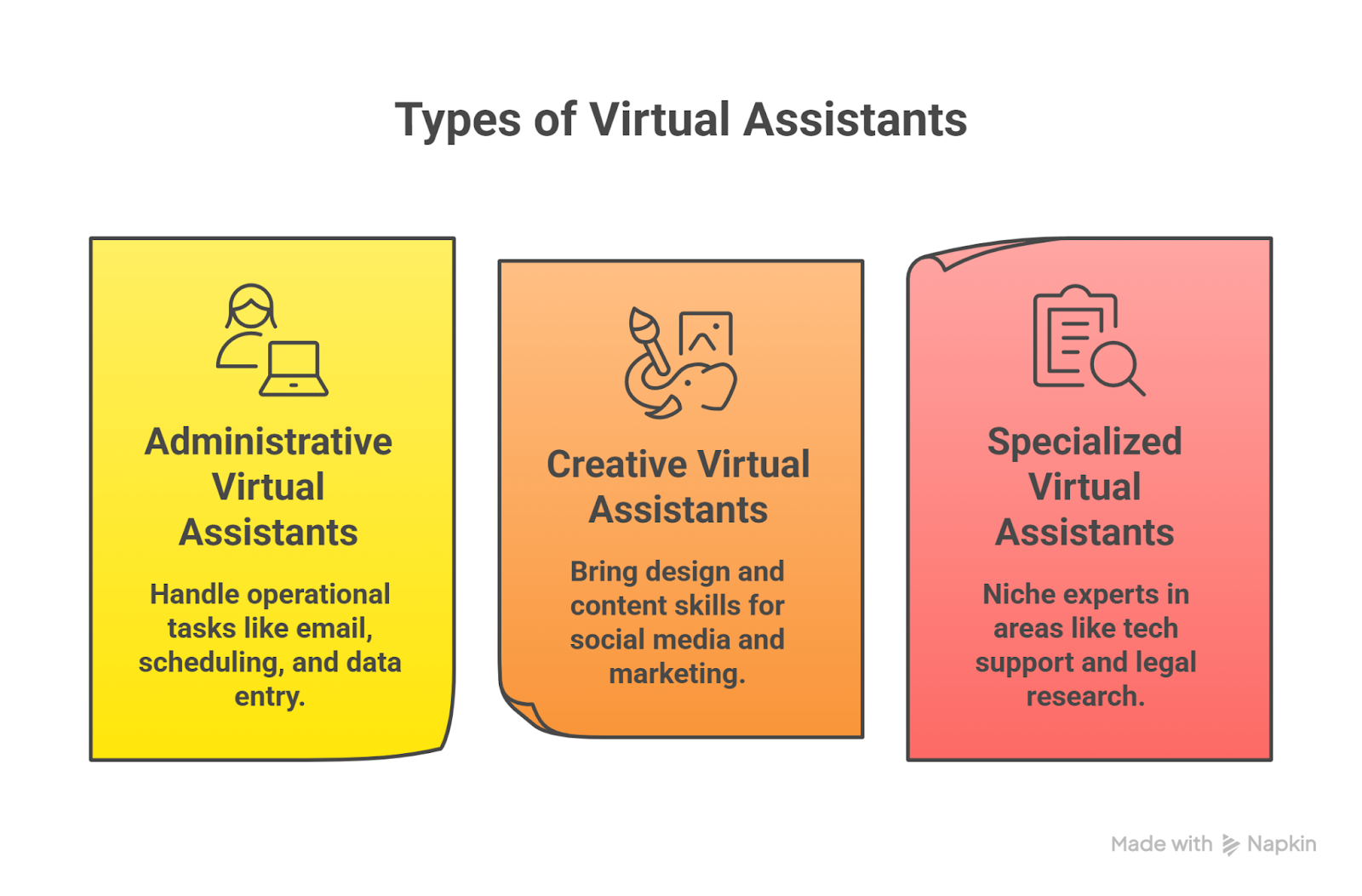
Choosing the right virtual assistants for startups ensures you get the mix of administrative, creative, and specialized support your team needs to scale efficiently. Hourly rates with CollabFabrik range from $6-$15 depending on the role.
These VAs excel at operational tasks: email and inbox management, calendar scheduling, travel planning, data entry, and bookkeeping basics. They're ideal for founders drowning in daily logistics.
These VAs bring design and content skills: social media management, content creation, graphic design, video editing, and email marketing. Creative VAs are perfect for startups needing consistent brand visibility.
These are niche experts: tech support, advanced bookkeeping, legal research, real estate administration, e-commerce management, and sales operations.
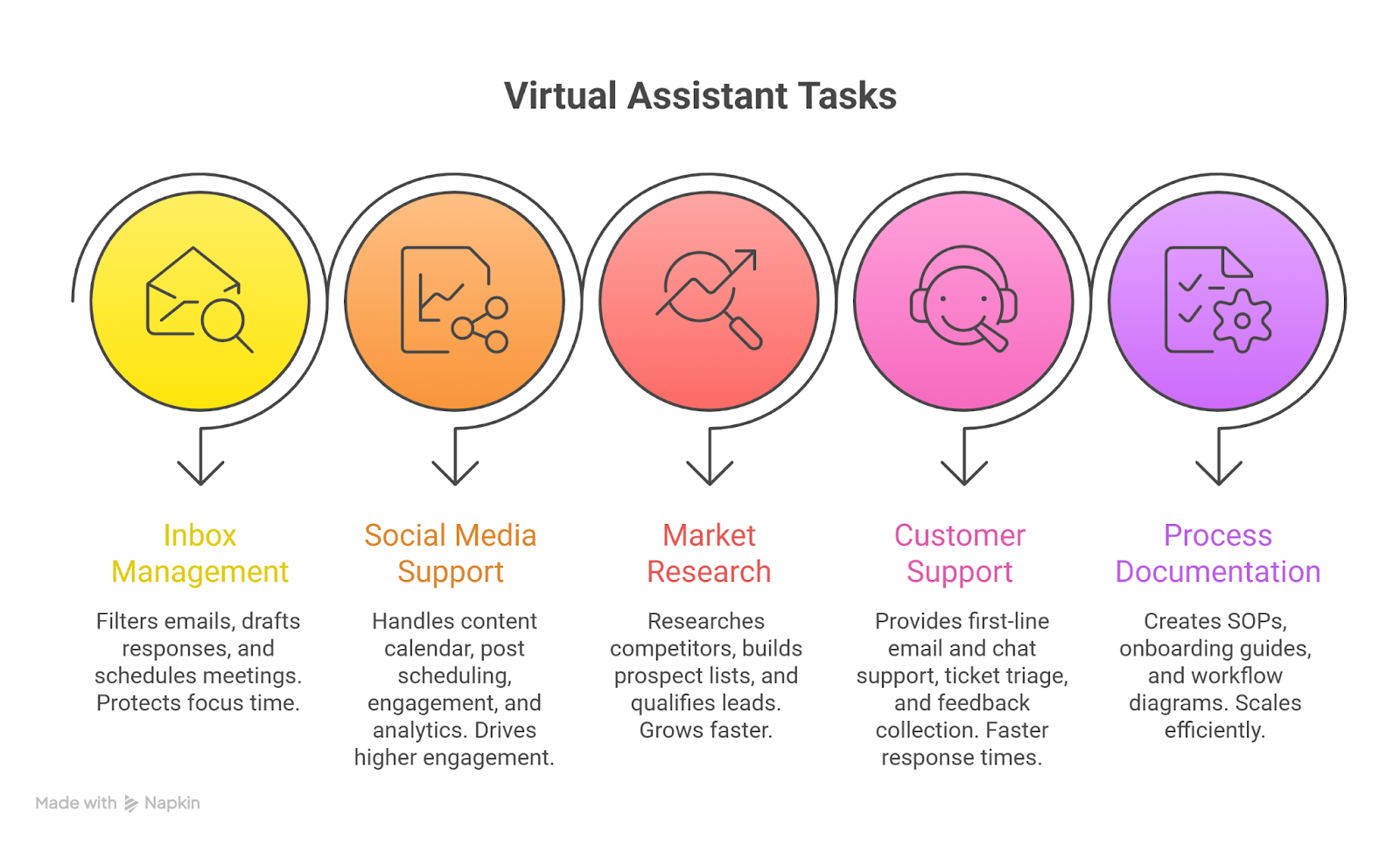
As of 2026, email serves over 4.73 billion users globally, more than half the world's population, processing 392.5 billion messages daily, according to The Radicati Group. A virtual assistant filters, categorizes, drafts responses, and schedules meetings while protecting focus time. Result: Founders reclaim 1-2 hours daily.
VAs handle content calendar planning, post scheduling, engagement, analytics, and basic graphic design. Consistent social media activity drives significantly higher engagement: accounts that post consistently see 4-5x more engagement per post compared to inconsistent posting, according to Buffer's 2025 analysis of over 100,000 social media users.
VAs research competitors, build prospect lists, compile industry reports, identify partnerships, qualify leads, and update CRM systems.
VAs provide first-line email and chat support, ticket triage, FAQ documentation, community moderation, and feedback collection.
VAs create SOPs, onboarding guides, tool tutorials, workflow diagrams, template libraries, and knowledge bases.
Finding the right virtual assistant shouldn't feel like another full-time job. That's where Collab Fabrik helps.
We're an EOR (Employer of Record) and outstaffing company specializing in connecting startups with skilled tech and administrative talent in Armenia, a growing hub for remote professionals with strong English proficiency, European time zone alignment, and competitive rates.
Pre-vetted, trained professionals: Every VA undergoes skills assessments, tool proficiency tests, and communication evaluations. You get candidates who can start contributing from day one.
Custom matching: We understand your business model, working style, and specific needs. Whether you need an administrative VA for 20 hours weekly or a specialized marketing VA full-time, we match talent that fits.
Armenia's talent advantage: Armenian professionals offer European working hours overlap (ideal for US East Coast and European startups), strong technical education, English proficiency, and rates 30-50% lower than Western Europe or North America.
Compliance handled: As your EOR, we manage payroll, contracts, local labor law compliance, and benefits administration. You focus on working with your VA: we handle employment logistics.
Flexible arrangements: Start with part-time support and scale to full-time as needed. No long-term contracts, just flexible partnerships that adapt to your startup's trajectory.
Ready to reclaim 30-40 hours monthly? Schedule a free consultation to explore how Collab Fabrik's virtual assistant services can accelerate your startup's growth.
Before your VA's first day, document your top 10 repetitive tasks, define success metrics, create process guides, and set communication norms. Many founders use Loom, Zoom, or simple screen recordings to show exactly how tasks should be completed.
Your VA's effectiveness depends on proper access: project management tools (Asana, Trello, Notion), communication platforms (Slack, Zoom), document sharing (Google Workspace), and password management (1Password). For more on secure remote collaboration, check our glossary on data security practices.
Don't overwhelm yourself or your VA. Start with 2-3 simple tasks in weeks 1-2, add 3-5 more in weeks 3-4, then gradually hand off entire domains in month 2+. This incremental approach reduces micromanagement anxiety and builds confidence.
Use asynchronous updates via Slack or Loom for daily check-ins. Schedule 30-minute weekly syncs to review progress. Provide specific, actionable feedback.
Scaling a startup requires focus on what only you can do: vision, strategy, and relationships. Virtual assistants handle everything else, giving you back 30-40 hours monthly at a fraction of traditional hiring costs. Whether you start with inbox management or build a full remote team, the question isn't whether you can afford a VA: it's whether you can afford not to have one. Ready to scale smarter? Schedule your free consultation with Collab Fabrik today and discover how the right virtual assistant can transform your startup's trajectory.
A virtual assistant provides ongoing administrative, creative, or specialized support. Unlike freelancers who work on specific projects, VAs handle recurring operational tasks like inbox management, scheduling, and customer support, integrating into your daily workflows as team members.
Virtual assistant pricing varies by skill level and role. According to our internal data at CollabFabrik, hourly rates range from $6-$15 depending on the position. For example, a virtual assistant at $8/hour costs approximately $8,320 annually for part-time support (20 hours per week) or $16,640 for full-time support (40 hours per week), making it significantly more cost-effective than hiring full-time employees with benefits and overhead.
VAs handle administrative tasks (email, scheduling, data entry), creative work (social media, content, design), and specialized functions (bookkeeping, lead generation, customer support). The general rule: if a task is repetitive, time-consuming, or outside your core expertise, it's likely VA-delegable.
Our process of hiring a virtual assistant takes under 7 days from initial consultation to your VA starting work, compared to traditional hiring (4-6 weeks) or freelance platform vetting (2-3 weeks). This speed becomes a competitive advantage when racing against product deadlines.
This depends on location. Many VAs work from regions creating time zone differences, which is often an advantage: you assign tasks at day's end; they're completed overnight. Armenia-based VAs overlap well with European and US East Coast time zones (9 AM - 6 PM Yerevan = 1 AM - 10 AM EST).
Collab Fabrik offers replacement guarantees. If a VA isn't meeting expectations despite clear communication, we find a better match, typically within 3-5 days. This prevents months of frustration that freelance platforms can't address.
Yes, with proper protocols: NDAs, role-based access controls, secure password sharing, and regular security training. Collab Fabrik ensures VAs undergo data security training aligned with GDPR and SOC 2 standards, providing peace of mind for startups handling customer data.
We combine upfront vetting (skills assessments, tool proficiency tests, reference checks) with ongoing oversight (monthly performance reviews, quarterly business reviews). Unlike freelance platforms, Collab Fabrik acts as an extension of your HR team. Learn more about our EOR services.
CollabFabrik goes beyond simple matching. We handle sourcing, vetting, onboarding, payroll, compliance, and ongoing performance support so founders can stay focused on growth. Through our outstaffing services, startups get long term team members who integrate into daily workflows without the administrative burden of traditional hiring.
If you're spending 10-15 hours weekly on email, scheduling, and operational tasks, you're leaving growth on the table. Virtual assistants for startups aren't about outsourcing busywork; they're about reclaiming time to build, sell, and scale.
The data speaks for itself: founders save 30-40 hours monthly, reduce operational costs by 50-70%, and access specialized skills they couldn't otherwise afford. Whether you need administrative support, creative help, or specialized talent, the right VA becomes your competitive advantage.
At Collab Fabrik, we connect startups with top-tier virtual assistant talent in Armenia: professionals who combine technical skills, European time zone alignment, and startup-friendly rates. We handle vetting, compliance, and ongoing support so you can focus on growth.
Ready to get 30 hours back in your schedule? Schedule a free 15-minute consultation and discover how Collab Fabrik's virtual assistant services can help your startup scale faster, leaner, and smarter.